

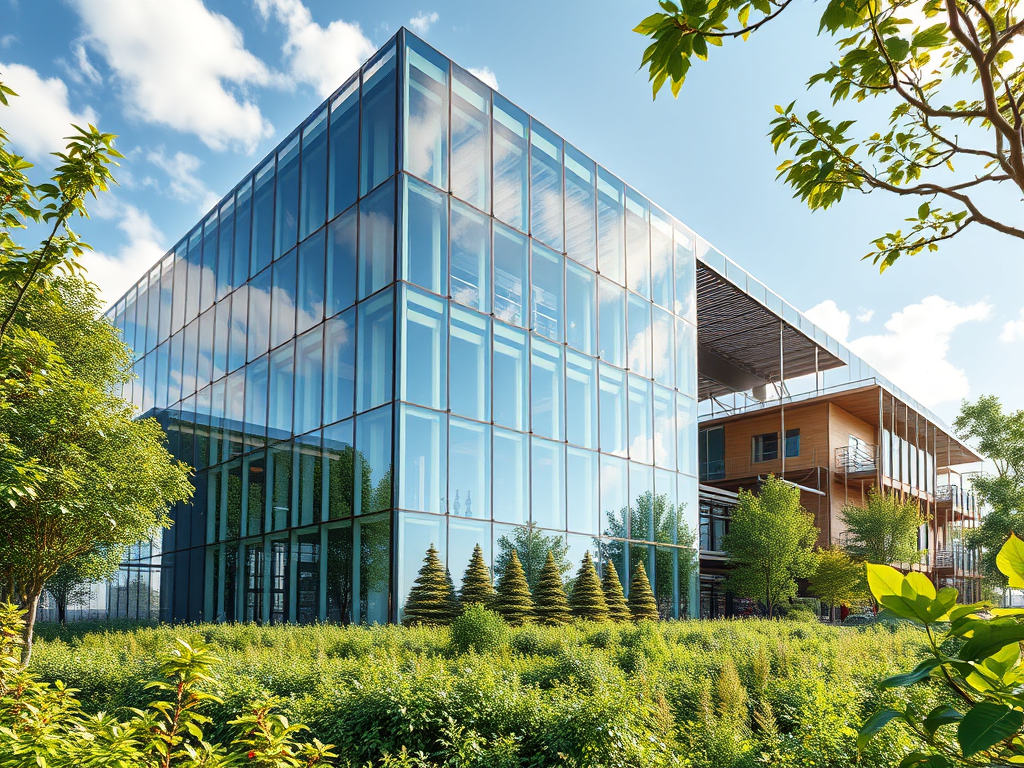
It often begins with a promise made of glass.
A polished façade that mirrors the sky. A lobby that smells like fresh concrete and fresh ambition. A plaque on the wall that whispers efficient, certified, under control. But the architecture of the future won’t be a promise. It will be proof. A building that doesn’t merely look green, but behaves green—through its entire life, in every screw, every kilowatt-hour, every raindrop that hits the roof and is welcomed instead of wasted.
We’re entering an era in which architecture is no longer primarily about shaping space. It’s about stewarding resources—carbon, water, land, biodiversity, human attention, and human health—with an intelligence so seamless, and a beauty so persuasive, that we actually want to live inside the change.
Because a sustainable building that feels like a compromise is not the future. The future is a place you choose—again and again—because it makes your life better.
1) From “Doing Less Harm” to “Leaving a Positive Footprint”
For years, sustainability in the built environment has been framed as reduction: lower energy demand, less waste, fewer emissions. That is necessary—and still urgent. But the horizon is shifting toward a more ambitious idea: regenerative design.
Regenerative architecture doesn’t ask, How can we damage less?
It asks, How can we help more?
Imagine a home that produces more energy than it consumes, not as a marketing headline but as a quiet daily reality. A school that stores rainwater and turns storms into a learning tool instead of a drainage crisis. A workplace that cools its microclimate with trees, shaded courtyards, and porous surfaces—reducing heat stress in summer while making lunch breaks feel like relief, not escape.
This is the new ethical baseline: buildings that support ecosystems, strengthen communities, and reduce emissions not only in operation—but in their materials, construction, and end-of-life. The future doesn’t want “less bad.” It wants net good.
2) The Materials Revolution: Building as Carbon Storage
If energy use is one half of architecture’s climate story, materials are the other—often the hidden half. Long before a building turns on its lights, it has already emitted or stored carbon through extraction, manufacturing, transport, and assembly. This is what’s often called embodied carbon, and it is increasingly impossible to ignore.
So the future smells less like brand-new cement and more like timber, clay, lime, hemp, straw, recycled steel—and materials we haven’t yet learned to treat as ordinary.
What’s changing?
- Mass timber and hybrid structures can replace high-carbon structural systems in many building types and, critically, store carbon during their lifespan.
- Lower-carbon concretes and alternative binders are advancing where concrete remains necessary—foundations, infrastructure, and certain structural demands.
- Bio-based insulation (wood fiber, cellulose, hemp, cork) can reduce fossil-based materials while supporting healthier moisture behavior in building envelopes.
- Non-toxic finishes and healthier interiors are becoming central, not optional—because a “green” building that off-gasses harmful chemicals is a contradiction in terms.
Material choice is no longer purely a technical decision. It’s climate accounting, public health, and cultural identity—fused into the walls.
And once you start looking at buildings this way, you realize something startling:
A building is not a static object. It’s a temporary arrangement of matter—borrowed from the Earth, to be returned in one form or another.
3) Circular Architecture: Buildings Designed to Come Apart
Most modern buildings are assembled as if they will last forever—and then demolished as if none of their parts matter. They are glued, cast, welded, sealed, and layered into a composite of intentions that becomes painfully expensive to adapt and nearly impossible to disassemble without turning value into rubble.
The future flips the script. Everything becomes recoverable.
Circular architecture designs for:
- Mechanical fasteners instead of permanent adhesives
- Modular systems rather than monolithic assemblies
- Standardized dimensions that allow components to be swapped
- Accessible service zones so systems can be repaired without destroying finishes
- Material passports—digital records that document what’s in the building, where it is, and how it can be reused or recycled
In a circular economy, a building is not the final destination of materials. It’s a bank. A warehouse of future resources. A reservoir of value.
And this changes aesthetics, too. The joints become honest. The layers become readable. A building’s capacity to evolve becomes part of its beauty.
4) The Building as a Climate Machine—Without Feeling Like One
The most sustainable energy is the energy you never need to use. Which is why the future—quietly but decisively—returns to what great architecture has always understood: work with nature first, technology second.
Before sensors. Before automation. Before “smart.”
Orientation, shading, massing, ventilation, and daylight are the original sustainability tools. And they are becoming central again—not as nostalgia, but as strategy.
Expect more:
- Deep overhangs and adaptive shading that respond to seasonal sun
- Narrower floor plates that pull daylight deeper into interiors
- Cross-ventilation and stack effect strategies that reduce reliance on mechanical cooling
- Courtyards and thermal buffers that moderate temperature swings
- Materials that provide thermal mass in the right places, not everywhere
Technology still plays a role—but the best technology in sustainable architecture is the kind you barely notice. Systems that learn patterns and optimize comfort. Controls that reduce peaks and support grid stability. Heat recovery that feels like common sense. Smartness as support, not spectacle.
The ideal future building doesn’t feel like a gadget.
It feels like calm.
5) Water as a Design Partner, Not a Problem
Climate change doesn’t just raise temperatures. It reshapes rainfall—more intense storms, longer dry spells, more unpredictable extremes. The future of architecture treats water as something to manage gracefully.
Instead of sending rain off-site as fast as possible, regenerative buildings often hold, filter, and reuse.
Design strategies include:
- Green roofs that slow runoff and cool the roof surface
- Rain gardens and bioswales that absorb and cleanse stormwater
- Permeable pavements that let the ground do what it’s meant to do
- Greywater systems that reuse water for flushing or irrigation where regulations allow
- Landscapes designed as infrastructure—beautiful, functional, resilient
In the best projects, stormwater solutions are not hidden underground. They’re visible, legible, even poetic: a shallow channel that turns rainfall into a soundscape; a courtyard that becomes a reflective pond after a storm; a planted depression where water lingers like a guest, not an emergency.
6) Nature Moves In—Not as Decoration, but as Structure
The future is not simply “more plants.” It’s ecological thinking woven into the skeleton of the built environment.
This means:
- Microhabitats integrated into façades
- Native planting strategies that support pollinators
- Green corridors that connect fragmented ecosystems
- Urban forests that reduce heat islands, improve air quality, and create psychological relief
And it means understanding something we’ve been slow to admit:
Cities are not separate from nature. They are a type of ecosystem—one we designed poorly, and can redesign better.
Sustainable architecture, at its best, becomes an act of reconciliation: between human life and more-than-human life.
7) Human Sustainability: Comfort, Health, and Belonging
A building can hit every environmental target and still fail if it makes people miserable.
The future of sustainability will be judged not only in carbon metrics, but in human outcomes:
- Indoor air quality
- Acoustic comfort
- Daylight and circadian-friendly lighting
- Non-toxic materials and low-emitting products
- Thermal comfort that doesn’t require constant tinkering
- Spaces that reduce stress and support connection
We will also see more architecture designed for changing lives: flexible layouts, adaptable units, and buildings that can be repurposed rather than abandoned.
And on the neighborhood level, sustainability becomes deeply social:
- Shared spaces that reduce individual resource use (guest rooms, workshops, communal gardens)
- Walkable planning that makes low-carbon choices effortless
- Mixed-use areas where daily needs are close, not a commute away
- Public spaces that invite—not repel—community life
Because one of the most overlooked truths about sustainability is this:
Loneliness has a carbon footprint.
Communities that share, cooperate, and stay close tend to consume less—and live better.
8) The Beauty Shift: From “Perfect” to “Honest”
Here’s one of the most exciting parts: sustainability is changing what we find beautiful.
The coming aesthetic is often:
- More texture, less flawless polish
- More visible joinery, fewer hidden tricks
- More local material identity, less global sameness
- More patina, less disposable newness
Reused bricks. Weathered timber. Salvaged stone. Visible layers that tell the truth: this came from somewhere; it mattered before; it will matter again.
In this sense, sustainable architecture becomes a new kind of luxury: not the luxury of excess, but the luxury of integrity—materials and spaces that have a conscience.
9) Data, Digital Twins, and the End of Guesswork
The future of sustainable architecture is also a future of accountability.
Tools that model operational energy, daylight, airflow, embodied carbon, and lifecycle impacts are becoming standard. But the bigger shift is cultural: design teams and clients increasingly want to measure, not just claim.
This includes:
- Lifecycle assessment (LCA) integrated early in design
- Embodied carbon targets alongside cost and schedule
- Commissioning and post-occupancy evaluation to verify performance
- “Digital twins” that track building behavior over time and support maintenance and optimization
The uncomfortable truth is that many “green” buildings have underperformed because they were judged at completion, not in use. The next generation will be judged in reality: comfort, energy, emissions, durability—year after year.
And that’s good news. Because the future needs fewer slogans and more receipts.
10) The Hard Part: Speed, Scale, and the Buildings We Already Have
The most sustainable building is often the one that already exists.
New construction matters—especially if it’s done right. But a large share of future emissions depends on renovation, retrofits, and adaptive reuse. This is where architecture becomes both practical and radical: turning old offices into housing, upgrading envelopes, electrifying heating, improving ventilation, adding insulation, and extending lifespans.
The future will reward:
- Deep energy retrofits
- Careful preservation paired with modern performance
- Reuse of structure and foundations where possible
- Design that treats constraints as creative fuel
There’s a quiet elegance in renovation. A sense of humility. A respect for what’s already been spent—in carbon, in labor, in history. It’s architecture that refuses to waste the past.
A Final Question: Can Architecture Make Hope Feel Real?
So much climate conversation tastes like sacrifice. Like shrinking horizons. Like doing with less.
But architecture can do something else. It can make change tangible. You can walk into it. Feel it. Hear its silence. Notice that the air is clean and the light is generous. Realize that the building is comfortable without struggling against the world outside it.
The future of sustainable architecture isn’t a single style. It’s a discipline of care: for materials, for energy, for water, for ecosystems, for human bodies and human lives.
It’s the moment we decide that buildings should not merely occupy the Earth—
they should belong to it.
Share this:

Discover more from Jarlhalla Group
Subscribe to get the latest posts sent to your email.