
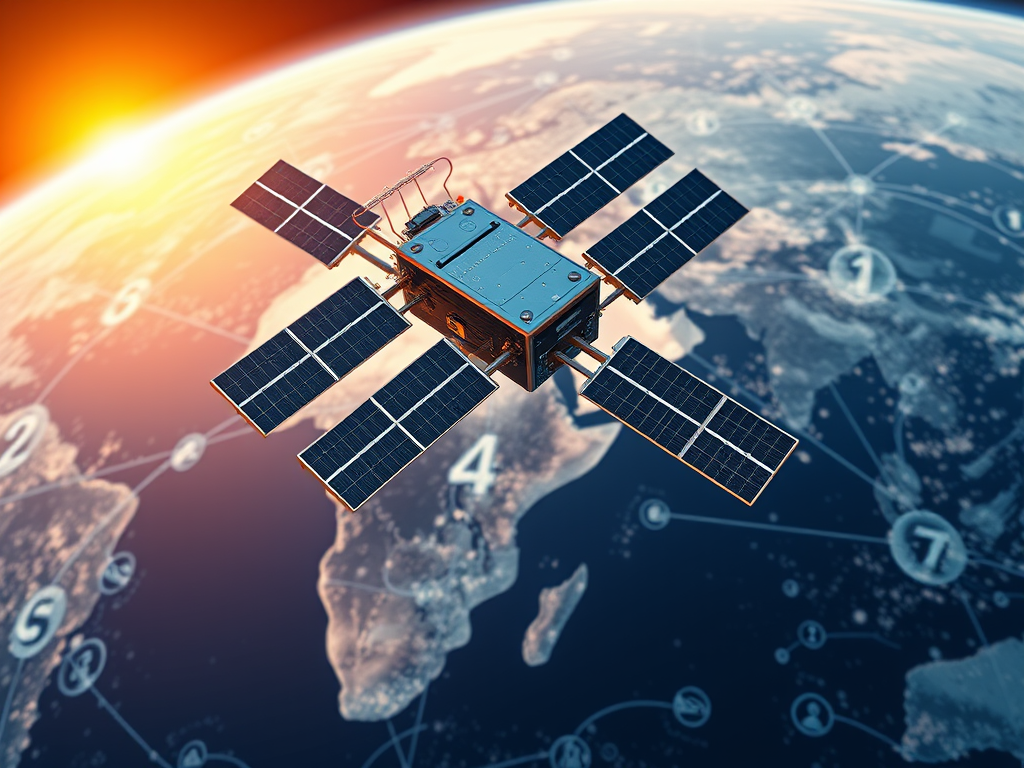
Introduction: When “No Signal” Becomes Obsolete
For decades, mobile coverage maps have been marketing fiction as much as engineering reality. Even in wealthy regions, anyone who hikes, sails, lives rurally, or works on infrastructure knows the familiar frustration: dead zones where smartphones become inert glass slabs. Globally, billions still live without reliable mobile internet, despite being within reach of terrestrial networks on paper.
A new technological and market shift aims to change that: direct‑to‑cell (D2C) satellites, also known as direct‑to‑device or satellite‑to‑phone connectivity. Instead of requiring bulky satellite phones or specialized hardware, these systems promise to connect standard 4G/5G smartphones directly to satellites, using existing radios and SIM cards. Major operators and satellite companies—from SpaceX/Starlink and T‑Mobile to AST SpaceMobile and Lynk Global—are moving from spectacular demos to commercial deployments, launching satellites explicitly optimized to talk to ordinary phones.1112131415
This article offers a comprehensive, structured exploration of direct‑to‑cell satellites as they enter real‑world service. We will:
- Trace the historical context of satellite communications and how standards like 3GPP Release 17 Non‑Terrestrial Networks (NTN) unlocked direct smartphone connectivity.
- Analyze the current relevance, including coverage gaps, technology trends, deployments, and business models.
- Examine practical applications, with case studies of carriers and satellite operators marketing “no dead zones” services.
- Explore future implications for global connectivity, emergency response, IoT, sustainability, and regulation.
The tone is professional yet accessible, aimed at technologists, strategists, and decision‑makers looking to understand how this shift could reshape mobile networks and connectivity globally.
1. Historical Context: From Satphones to 3GPP NTN
1.1 Early Satellite Telephony: Specialized, Expensive, Niche
Satellite communication predates mobile phones by decades, starting with early geostationary satellites for TV, telephony backhaul, and data links. For direct user connectivity, the first wave of satellite phones arrived in the 1990s with systems like Iridium and Globalstar.
Characteristics of this first wave:
- Special hardware: Users needed dedicated satellite handsets with large antennas.
- High latency and limited bandwidth: Often suitable only for voice and low‑rate data.
- High cost: Handsets and per‑minute/MB prices far above terrestrial mobile.
- Professional niche: Maritime, aviation, military, remote exploration, oil & gas.
These systems were essential in specific sectors but never approached mass‑market adoption. The typical citizen did not carry a satphone, and the coverage gap between urban cellular networks and remote areas persisted.
1.2 The Rise of Terrestrial Mobile—and Persistent Dead Zones
Meanwhile, terrestrial mobile networks (2G, 3G, 4G, 5G) spread rapidly. By 2024, 4G networks covered about 99% of the world’s urban population, but only ~82% of rural populations.6 Coverage maps conceal regional disparities: low‑income and sparsely populated regions are under‑served, and even within high‑income countries, large patches—mountains, forests, oceans, deserts—remain unconnected.
At the same time, connectivity gaps are not purely about coverage:
- The GSMA estimates that in 2024, 3.4–3.45 billion people—around 43% of the global population—do not use mobile internet, despite many living within coverage footprints.7910
- This includes both a coverage gap (no 3G/4G/5G at all) and a usage gap (coverage exists, but affordability, skills, relevance, and device constraints prevent adoption).710
Dead zones in high‑income areas undermine safety and convenience; dead zones in low‑income and remote regions block access to education, health information, economic opportunity, and emergency services.
1.3 Early Direct‑to‑Device Experiments
As smartphones became ubiquitous, engineers and startups began asking: Could satellites talk directly to the phone already in your pocket? Several threads converged:
- Better RF front‑ends and baseband chips in smartphones, capable of handling a wide range of bands and modulation schemes.
- Low Earth Orbit (LEO) satellite constellations (e.g., Starlink, OneWeb) offering lower latency and higher link budgets than traditional geostationary systems.
- Interest from mobile network operators (MNOs) in extending coverage without building expensive towers in sparsely populated areas.
Early pioneers like Lynk Global successfully demonstrated text messaging to unmodified phones using prototype LEO satellites around 2019–2020, showing that 3GPP‑like waveforms could be received by regular devices from space (at least for low‑rate services).
1.4 Standardization: 3GPP Release 17 and Non‑Terrestrial Networks
The crucial turning point was the standardization of satellite‑to‑device connectivity in mainstream cellular standards.
The 3rd Generation Partnership Project (3GPP), which defines global mobile standards, introduced formal support for Non‑Terrestrial Networks (NTN) in Release 17, completed around 2022.123
Key Release 17 NTN contributions include:
- Extension of 5G NR to support satellite channels (L‑band, S‑band, other bands), with adjustments for:
- Alignment with NB‑IoT and LTE‑M for low‑power, narrowband satellite IoT use cases.
- Definition of architecture for integrated terrestrial–non‑terrestrial connectivity—i.e., satellites connecting into the same 5G core network as ground base stations.35
This was pivotal because it:
- Created a standard air interface and signaling framework for satellite‑to‑smartphone connectivity.
- Provided incentives for smartphone chip vendors, mobile network operators, and satellite companies to build interoperable solutions.45
- Shifted direct‑to‑device satellites from one‑off proprietary experiments to a path within the mainstream cellular ecosystem.
Release 17 laid the groundwork; Releases 18–19 continue refining NTN performance and capabilities.5
2. Current Relevance: Why Direct‑to‑Cell Matters Now
2.1 The Coverage and Connectivity Gap
As of 2024:
- 4G coverage: ~99% of urban populations and ~82% of rural populations globally, with big regional disparities.6
- 5G coverage: reaching about 51% of the world’s population, again with disparities between high‑ and low‑income regions.8
- Usage gap: About 39–43% of the global population (≈3.4–3.45 billion people) still do not use mobile internet.7910
Direct‑to‑cell satellites address primarily the coverage gap, not the usage gap, but closing coverage is a prerequisite for unlocking usage, especially for remote communities, maritime routes, aviation corridors, and critical infrastructure in isolated locations.
In high‑income regions, “no dead zones” is framed as:
- seamless messaging when hiking or sailing;
- reliable connectivity in disaster zones where terrestrial networks fail;
- continuous coverage for logistics, agriculture, and infrastructure monitoring.
In emerging markets, it may be more about:
- first‑time connectivity for remote villages without towers;
- improved access to education, health, and markets;
- resilience when terrestrial infrastructure is underdeveloped or fragile.
2.2 From Marketing Slides to Commercial Offers
We are now firmly in the phase where carriers and satellite operators are marketing real services, not just showing demos.
Starlink Direct to Cell (with T‑Mobile and others)
- Starlink’s Direct to Cell service is advertised as working with “every LTE phone wherever you can see the sky”—no hardware changes required.11
- T‑Mobile (US) markets T‑Satellite with Starlink, promising satellite phone service that keeps customers connected “almost anywhere you can see the sky” for messaging and basic data.1215
- The initial service tiers are text messaging and basic data and IoT connectivity, with voice and full broadband as future phases.1112
AST SpaceMobile
- AST SpaceMobile is building a large LEO constellation of “BlueBird” satellites designed specifically for direct‑to-cell links.
- In 2024–2025, AST launched its most powerful BlueBird satellites yet, capable (on paper and in tests) of 3G/4G broadband to unmodified smartphones.14
- AST has partnerships or MOUs with major operators including AT&T, Vodafone and others, targeting both developed and emerging markets.1314
Lynk Global
- Lynk pioneered early D2D text messaging demos and has commercial agreements with multiple regional operators to provide SMS‑over‑satellite as a roaming‑like service in coverage gaps.13
Multiple other projects—including some aligned with traditional MSS operators—are exploring NB‑IoT/IoT‑focused direct‑to‑device links for sensors, agriculture, and logistics.
2.3 Technology Stack: How Can a Phone Talk to Space?
Direct‑to‑cell is possible because of a careful co‑design of satellites, waveforms, and network architecture, rather than magic upgrades to consumer phones.
Key elements:
- Large phased‑array antennas in LEO
Satellites use huge, high‑gain antennas to focus beams on small ground areas, effectively amplifying signals enough that a phone’s tiny antenna can be heard. - Compatibility with LTE/NR waveforms
D2C systems often use LTE (4G) or NR (5G) waveforms adapted for high Doppler and delay, but still recognizable by commercial smartphone basebands (with potentially some firmware tweaks).13 - NTN support in network core
Satellites are integrated as a kind of “moving cell tower in the sky”, connecting into the mobile operator’s core network. To the network, a satellite looks like a special base station in a remote region.35 - Spectrum sharing and coordination
In some models, MNOs provide licensed spectrum in certain bands; in others, satellite operators use their own bands. Coordination with terrestrial towers is critical to avoid interference.
Because this is built atop 3GPP NTN standards, smartphones do not need exotic new radios. Over time, new phone generations will explicitly support NTN profiles, improving performance, but early deployments focus on compatibility with existing LTE phones.
2.4 Business Models and Commercial Framing
Current commercial framing focuses on:
- Safety and resilience: emergency messaging and fallback connectivity when towers are down or out of reach.
- Incremental coverage: filling in rural dead zones without expensive tower deployment.
- Roaming‑like extensions: direct‑to‑cell as a premium add‑on or bundled feature in higher‑tier mobile plans.
- IoT verticals: agriculture, maritime, logistics, energy, and environmental monitoring.
Some operators pitch satellite connectivity as “always on” background connectivity: your phone transparently switches between towers and satellites, possibly with degraded data rates but maintained reachability.
Pricing models are still evolving: they range from bundled emergency coverage to usage‑based pricing for data, and higher ARPU plans that include satellite as a differentiator.
3. Practical Applications and Case Studies
3.1 Emergency Communications and Disaster Resilience
Use Case: Natural Disaster in a Coastal Region
When hurricanes, wildfires, or earthquakes strike, terrestrial infrastructure (towers, fiber backhaul, power) can fail. Direct‑to‑cell satellites offer:
- Basic messaging to coordinate rescue, share location, and confirm safety even when towers are down.
- Broadcast alerts to all phones in a region with satellite visibility, regardless of terrestrial network status.
- Resilient government and NGO communications for coordination and logistics.
For example, T‑Mobile markets its Starlink partnership as a way to “keep you connected almost anywhere”, with particular emphasis on emergency use in rural areas and along highways.1215 In the coming years, we can expect regulators and emergency agencies to integrate direct‑to‑cell into public warning systems.
3.2 Rural and Remote Coverage: From Farms to Fjords
Use Case: Agriculture in Remote Areas
A farmer in a sparsely populated region may have intermittent or no coverage in fields, but D2C satellites can:
- Bring basic coverage to standard phones, enabling voice and messaging for workers.
- Enable IoT sensors on soil, machinery, and livestock using NB‑IoT‑over‑satellite profiles, feeding data to farm management systems.
Rather than building towers for a small number of users across vast areas, operators use satellite coverage to fill in gaps more economically.
Use Case: Coastal Communities and Fisheries
Fishing boats or coastal communities often operate just beyond reliable terrestrial coverage. Direct‑to‑cell:
- Provides connectivity out to tens or hundreds of kilometers from shore.
- Enables safety services (distress signals, location sharing).
- Supports supply chain and market information (e.g., fish prices, weather, port schedules).
3.3 Maritime, Aviation, and Logistics
Maritime
Traditional maritime satcom has been dominated by specialized terminals (Inmarsat, Iridium). Direct‑to‑cell adds:
- Low‑bandwidth smartphone coverage for crew and passengers without specialized handsets.
- Integration with existing mobile numbers and apps (WhatsApp, SMS, etc.).
Aviation
Aircraft can use D2C for:
- Backup connectivity, especially in smaller aircraft without full satcom suites.
- Passenger messaging at lower cost than full broadband Wi‑Fi, particularly on regional and low‑cost carriers.
Logistics and Transport
Trucks, trains, and remote infrastructure benefit from:
- Tracking and telemetry through NB‑IoT/NR NTN.
- Driver communications in remote corridors.
3.4 AST SpaceMobile: Testing Broadband from Space
AST SpaceMobile’s BlueWalker 3 and subsequent BlueBird satellites have conducted high‑profile tests:
- Demonstrating 4G LTE and even 5G‑class data sessions directly to unmodified smartphones on the ground.
- Showing video calls and broadband‑like experiences, albeit with limited capacity per satellite.
AST’s business model aims at providing full cellular broadband, not just messaging, by using very large phased arrays and sophisticated beamforming. Partnerships with operators like AT&T and Vodafone give AST access to spectrum and customer bases.1314
These demos illustrate the upper end of D2C potential: a future where your phone might stream video or handle standard app traffic via satellite in truly remote settings.
3.5 Lynk Global: SMS as the First Service
Lynk Global has taken a more incremental path:
- Focusing initially on store‑and‑forward SMS services to standard phones, which require less real‑time capacity and are easier technically.
- Partnering with smaller and regional MNOs to offer “coverage extension” services where Ly nk satellites act as roaming partners in uncovered areas.13
This case shows that you do not need full broadband to deliver meaningful value: basic text messaging in dead zones can dramatically improve safety and utility.
3.6 Starlink Direct to Cell + T‑Mobile: Branded “No Dead Zones”
Starlink’s Direct to Cell business page highlights:
- Operation with every LTE phone wherever you can see the sky, targeting messaging, voice, and data in stages.11
- Use cases including remote work sites, offshore platforms, and rural areas.
T‑Mobile’s consumer‑facing messaging emphasizes:
- Seamless extension of T‑Mobile coverage; users don’t need to change phones or numbers.
- Use for emergencies and light use where terrestrial service is absent.
- Future expansion to data and IoT across North America.1215
This partnership is a clear example of the marketing narrative: “no more dead zones,” with D2C positioned as a natural extension of the operator’s existing coverage map, not a separate product.
4. Challenges in the Real‑World Rollout
4.1 Capacity and Performance Limits
Physics and economics impose constraints:
- Limited bandwidth per satellite must be shared among all users in view, so per‑user throughput can be modest.
- Early D2C services focus on text and low‑rate data; full broadband to many users in the same area is challenging.
- Beam sizes and power budgets mean there may be trade‑offs between coverage area and data rates.
In practice, this means that while marketing may show streaming in remote cabins, the initial reality is more about reliable messaging, emergency use, and light data rather than full terrestrial‑like broadband.
4.2 Spectrum, Regulation, and Interference
Direct‑to‑cell sits at the intersection of:
- National regulators who manage spectrum allocation and licensing.
- International bodies like ITU coordinating satellite bands.
- Mobile operators who own licensed terrestrial spectrum.
Key issues include:
- Whether satellites can reuse terrestrial bands in remote areas without interfering with ground towers.
- How to manage cross‑border interference when satellite beams cross national boundaries.
- Harmonization of emergency calling, lawful interception, and security obligations.
Regulatory frameworks are evolving; some countries are enthusiastic, others cautious, especially where local operators fear competition from global satellite players.
4.3 Device and Chipset Support
While D2C aims to work with “standard smartphones,” there are nuances:
- Early deployments may require specific firmware updates or chipset support for NTN features.
- Battery life impacts must be managed, as satellite links may demand more power.
- Form factor constraints mean phones cannot suddenly grow large antennas, so link budgets are tight, requiring sophisticated satellite hardware.
As 3GPP NTN support becomes mainstream in chipsets (Release 17/18 devices), D2C performance and reliability will improve. But for older devices, capabilities may be limited to basic messaging.
4.4 Economics and Equity
Direct‑to‑cell raises important questions about business sustainability and equity:
- Will satellite‑enabled plans be premium services affordable mainly to wealthier users, or will they become standard features?
- In low‑income regions, who pays for connectivity—end users, governments, NGOs, or cross‑subsidies from higher‑income markets?
- How do we ensure that closing coverage gaps does not exacerbate usage gaps, where people remain offline due to cost, skills, or relevance barriers?
Operators and policymakers will need creative models—for example, zero‑rating specific public services, subsidizing emergency capacity, or using universal service funds to support D2C coverage.
5. Future Implications: Toward a Planet with No Dead Zones
5.1 A New Layer in the Network Topology
Direct‑to‑cell satellites are not replacing terrestrial networks; they are adding a new, planetary‑scale layer:
- Terrestrial cells provide high‑capacity, low‑latency service in populated areas.
- Satellite cells fill in gaps, provide resilience, and enable global reach for low‑rate services and specialized applications.
Over time, we can imagine phones seamlessly roaming between towers, Wi‑Fi, and satellites, with applications adapting to the available bandwidth and latency.
5.2 Impact on IoT and Planetary Sensing
As NTN standards mature and more constellations launch, direct‑to‑device IoT could enable:
- Global asset tracking (shipping containers, vehicles, livestock).
- Environmental and climate monitoring (sensors in remote forests, oceans, glaciers).
- Structural monitoring of critical infrastructure (dams, bridges, pipelines) in remote locations.
Low‑power IoT profiles (e.g., NB‑IoT over NTN) are particularly attractive for sustainability and resilience use cases, enabling near‑real‑time insight into the state of the planet.
5.3 Safety, Security, and Geopolitics
Ubiquitous connectivity has deep societal implications:
- Safety and emergency response will be transformed if every hiker, sailor, or villager can send at least a message from anywhere with a sky view.
- Authoritarian regimes may try to restrict satellite connectivity or enforce national filtering, raising geopolitical tensions similar to those around satellite broadband.
- Satellites become even more strategic assets, and conflicts may extend into orbital domains.
Policy debates will intensify around privacy, surveillance, lawful interception, and cross‑border control of communications.
5.4 Environmental and Sustainability Considerations
Direct‑to‑cell constellations must also be evaluated through a sustainability lens:
- Space debris and orbital congestion: more satellites increase collision risks; responsible operators will need robust de‑orbiting and debris mitigation plans.
- Energy use: ground and space segments consume energy; however, D2C might reduce the need for towers and diesel generators in some remote regions.
- Environmental monitoring benefits could outweigh costs if D2C‑enabled IoT supports better climate adaptation and conservation.
Balancing these factors requires holistic planning and international cooperation.
5.5 Long‑Term Vision: Connectivity as a Basic Utility
If direct‑to‑cell matures, we may reach a world where:
- Every smartphone, by default, can call or message from anywhere on Earth given clear sky, even without towers.
- Coverage maps become less relevant; instead, we think in terms of service tiers (high‑capacity urban, lower‑capacity rural, satellite fallback).
- Universal, baseline connectivity is treated more explicitly as a global public good, akin to clean water or electricity, with satellite layers filling in the hardest‑to‑reach places.
Achieving this vision will require:
- Technical evolution (more efficient constellations, better NTN standards).
- Regulatory frameworks that encourage interoperability and fair access.
- Economic models that ensure equitable affordability.
Conclusion: From Demos in the Sky to Daily Life on Earth
Direct‑to‑cell satellites are transitioning from impressive engineering demos to live commercial deployments. 3GPP Release 17’s NTN standards provided the technical backbone; operators like Starlink, T‑Mobile, AST SpaceMobile, and Lynk have begun turning that backbone into services that regular people can experience on their existing smartphones.131112131415
Historically, satellite telephony was confined to specialized hardware and high‑end users. Today, by leveraging LEO constellations, large phased‑array antennas, and standards‑based waveforms, direct‑to‑cell promises:
- “No dead zones” messaging and basic connectivity almost anywhere you can see the sky.
- New layers of resilience for emergency communications and disaster response.
- More economical ways to extend coverage to rural communities, maritime domains, and remote industries.
At the same time, real‑world deployments reveal challenges:
- Limited capacity and modest data rates in early phases.
- Complex spectrum and regulatory landscapes.
- Device and chipset constraints.
- Economic and equity questions about who benefits and who pays.
Looking forward, direct‑to‑cell satellites could play a central role in building a world where baseline connectivity is ubiquitous, and where no one is entirely cut off simply because terrestrial infrastructure is sparse or fragile. They will not replace terrestrial networks but will weave a planetary safety net around them.
For technologists, policymakers, and operators, the current moment—where we shift from pilots to deployments—is pivotal. Decisions made now about standards, openness, pricing, and regulation will shape whether D2C becomes:
- a premium add‑on for a privileged few, or
- an integral part of a more inclusive, resilient, and sustainable global communications fabric.
The technology is here; satellites are launching; carriers are marketing. The next phase is cultural, economic, and political: turning “no dead zones” from a slogan into a lived reality for everyone, everywhere.
Share this:

Discover more from Jarlhalla Group
Subscribe to get the latest posts sent to your email.