

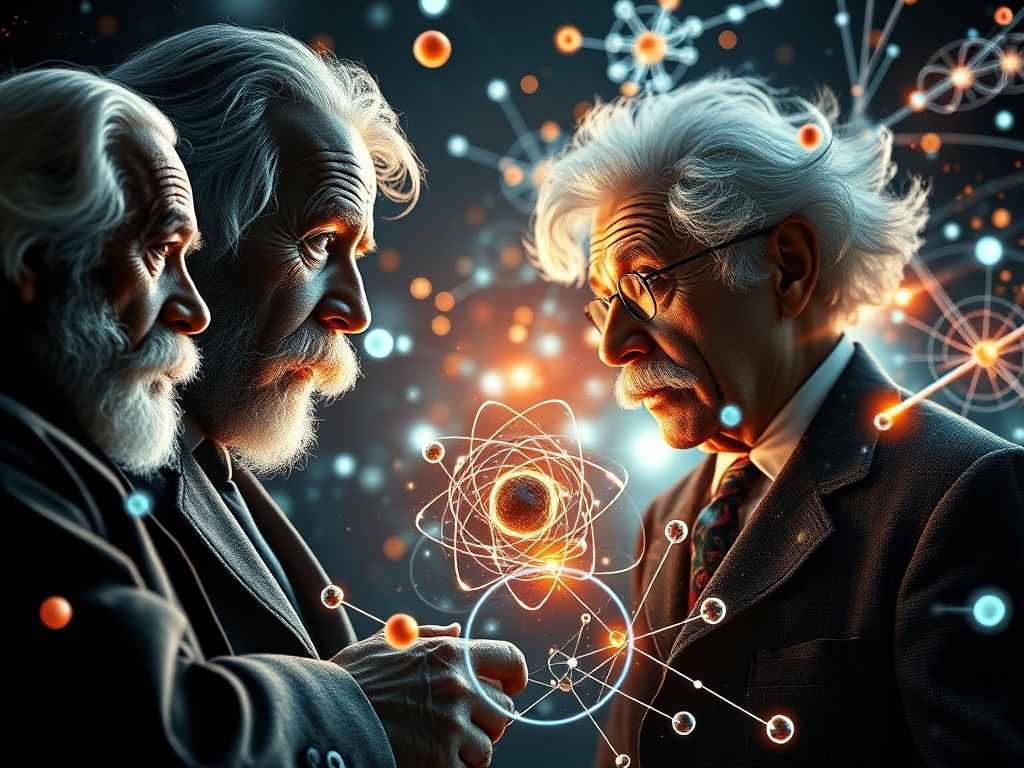
Quantum mechanics turns 100 not because the universe suddenly became mysterious in 1925, but because that year marked the decisive pivot from clever patchwork models to a coherent theory of the microscopic world. In the space of a few intense years—driven by arguments, new mathematics, and an insistence on what experiments actually show—physicists rebuilt the foundations of matter, light, and measurement. The result was not just a new worldview. It became an engineering language powerful enough to create the transistor, the laser, MRI scanners, and the emerging wave of quantum computing and quantum-secure communication (Pares, Aspropotamiti and Kaufmann, 2025). citeturn2view0
What makes the story so enduring is the tension at its core: quantum mechanics is simultaneously precise and unsettling. It predicts outcomes with extraordinary accuracy—yet it replaces certainty with probability, and it forces “measurement” to be part of the theory rather than a neutral window onto reality. A century on, it remains both the most successful framework we have for the small-scale universe and one of the most contested in terms of interpretation.
From “Crazy Paper” to New Physics: 1900–1927
Planck and Einstein: Quanta enter the conversation
The first crack in classical certainty appeared when Max Planck introduced the idea that energy exchange occurs in discrete packets—an initially mathematical move that explained stubborn experimental results. Albert Einstein pushed the implication further: light itself behaves as if it comes in quanta. The conceptual shift was radical, because it challenged the continuous, smooth assumptions embedded in classical physics (Pares, Aspropotamiti and Kaufmann, 2025). citeturn2view0
Bohr’s atom: jumps, not orbits
By the early 20th century, many physicists pictured atoms as miniature solar systems. Niels Bohr’s decisive move was to reject the comfortable metaphor. Electrons, he argued, do not move in smooth planetary orbits; they transition between discrete energy levels and emit or absorb light when they do—behaviour that seemed absurd precisely because classical theory had no room for it (Pares, Aspropotamiti and Kaufmann, 2025). citeturn2view0
Heisenberg on Helgoland: build the theory from observables
In 1925, Werner Heisenberg retreated to Helgoland, seeking relief from hay fever and conceptual clarity. His breakthrough was methodological: instead of describing what a particle “really is doing,” he built a formalism from measurable quantities—spectral lines, transition frequencies, energy levels. This became matrix mechanics, and it was among the first mature formulations of quantum theory (Pares, Aspropotamiti and Kaufmann, 2025; CERN Courier, 2025). citeturn2view0turn0search11
Schrödinger’s wave mechanics: different language, same physics
Almost simultaneously, Erwin Schrödinger developed wave mechanics, providing an intuitive mathematical picture in which quantum states behave like waves. In modern terms, the wave function encodes probabilities: it tells us where a particle is likely to be found when a measurement is performed. Crucially, Schrödinger’s approach proved mathematically equivalent to Heisenberg’s—two sides of the same coin (Schrödinger, 1926; Pares, Aspropotamiti and Kaufmann, 2025). turn2view0
The Copenhagen-era dispute that never fully ended
The immediate victory was predictive power. The lasting controversy was meaning. If particles are spread like waves, why do measurements yield single outcomes? If probabilities govern outcomes, what exactly “collapses,” and why? These questions are not fringe curiosities; they sit at the boundary between physics, philosophy, and the practical reality of building quantum technologies that must manage measurement and noise.
What Quantum Mechanics Actually Says (Minus the Mystique)
Superposition is a model of possibility—not a claim that “everything happens”
A quantum system is described by a state that can represent multiple potential outcomes at once (superposition). This is not mystical; it is a compact mathematical description that correctly predicts interference patterns and measurement statistics. The “weirdness” comes from the fact that the state is not a simple list of properties in the classical sense.
Measurement turns probabilities into outcomes
Quantum theory does not generally predict a single outcome for an individual event. It predicts a distribution of outcomes with calculable probabilities—then experiments validate those distributions. The interpretive debate concerns what the state represents (knowledge, reality, or something else), not whether the predictions work.
Entanglement: correlations that outperform classical expectations
Entanglement ties the statistics of separated systems together in a way that cannot be reproduced by classical “hidden variables” under standard assumptions. It does not let you send information faster than light, but it does enable technologies like quantum key distribution and forms of quantum computing.
Decoherence explains why the everyday world looks classical
Large systems constantly interact with their environment, rapidly dispersing delicate quantum coherence into correlations that are practically inaccessible. Decoherence does not settle every philosophical question, but it explains the engineering reality: quantum behaviour is fragile, and preserving it requires extraordinary control.
The First Quantum Revolution: Materials, Light, and the Digital World
Quantum mechanics became indispensable the moment engineers started asking not just “what is matter?” but “how do we reliably control matter?” Its early technological legacy is the infrastructure of modern civilization.
Semiconductors and the transistor: the quantum switch that built the information age
Quantum mechanics explains why electrons in crystals occupy energy bands and why some materials can be tuned to conduct or insulate—semiconductors. Once that behaviour was understood and engineered, the transistor became possible, replacing fragile vacuum tubes with compact, low-power switching and amplification. Bell Labs’ team demonstrated the first working transistor in 1947; the device and its descendants became the core of modern electronics (Pares, Aspropotamiti and Kaufmann, 2025; Nokia Bell Labs, n.d.). citeturn2view0turn1search5
Business-grade implication: every digital transformation strategy—from AI to IoT to cloud—rests on quantum-enabled semiconductor physics. The “quantum century” is not a future trend; it is the past 70 years of scaling quantum effects into reliable products.
Lasers and LEDs: quantum control of light
When engineers learned to manipulate electronic energy levels and photon emission, two transformative light sources followed: LEDs (efficient illumination and displays) and lasers (coherent, precise light). Lasers became foundational not only for barcodes and manufacturing, but for fibre-optic communications—one of the reasons global data traffic can move at near-light speeds through glass (Pares, Aspropotamiti and Kaufmann, 2025). citeturn2view0
Quantum sensing and MRI: when measurement becomes medicine
Quantum physics also enabled new classes of sensors and imaging methods. Magnetic resonance imaging (MRI), for example, evolved from advances in magnetic resonance and signal processing into a clinical tool that reshaped diagnostics worldwide (Nobel Prize, 2003; Pares, Aspropotamiti and Kaufmann, 2025). turn2view0
Quantum dots: “artificial atoms” in screens and solar cells
More recently, quantum dots—nanoscale structures that behave like tunable artificial atoms—have moved from lab curiosity to mass-market displays and emerging solar technologies, illustrating a recurring pattern: once quantum behaviour is engineered into stable platforms, it becomes scalable design.
The Second Quantum Revolution: Engineering Single Quanta (1990s–Now)
If the first quantum revolution was about understanding ensembles of atoms in materials, the second is about controlling individual atoms, photons, and engineered quantum states—and turning that control into strategic infrastructure.
Why 2025 matters: a global milestone, not just an academic anniversary
The United Nations proclaimed 2025 the International Year of Quantum Science and Technology, explicitly recognising the centenary of quantum mechanics and the societal significance of quantum research and innovation (United Nations, 2024).
Quantum-secure communication: security rooted in physics
Quantum cryptography leverages a blunt physical fact: observing a quantum state typically disturbs it. That makes certain eavesdropping attempts detectable in principle, enabling secure key distribution under well-defined assumptions. IBM’s overviews capture the mainstream framing: quantum cryptography aims to secure data transmission using quantum-mechanical laws rather than purely mathematical hardness (IBM, n.d.).
Strategic reality: quantum communication is not a blanket replacement for all cybersecurity, but it is highly relevant for specific threat models, especially where long-term confidentiality matters and where key exchange is the weak link.
Quantum sensing: precision measurement as an economic multiplier
Quantum sensors exploit interference, coherence, and atomic-scale reference systems to measure time, fields, and acceleration with extraordinary sensitivity. This affects navigation, geodesy, materials research, and potentially climate and infrastructure monitoring—areas where better measurement produces compounding value across industries (CERN, 2025).
Quantum computing: high potential, hard engineering
Quantum computing harnesses superposition and entanglement to explore computational spaces that classical machines cannot feasibly represent in full. The promise is strongest for targeted domains—quantum simulation of materials and molecules, certain optimization structures, and specific algorithmic advantages. IBM defines the field as harnessing quantum mechanics to solve problems beyond classical capabilities (IBM, n.d.).
However, the bottlenecks remain substantial: noise, error correction overhead, scaling, and the practical cost of maintaining coherence. This is why credible roadmaps increasingly distinguish between experimental demonstrations, near-term utility, and the longer path to fault-tolerant systems.
The Governance Problem: When Foundational Science Becomes Dual-Use Power
A century of benefits—and a record of misuse
Quantum mechanics enabled world-changing medical imaging and communications. It also enabled nuclear weapons. The shift from open scientific exchange to secret programs during wartime illustrates how quickly a research field can become militarised (Pares, Aspropotamiti and Kaufmann, 2025). citeturn2view0
Bohr’s 1950 argument: openness as a security strategy
In 1950, Niels Bohr urged the international community toward openness and cooperation, framing transparency and shared knowledge as stabilising forces in a world transformed by atomic power (Bohr, 1950). turn0search7
This is not naïve idealism; it is a governance thesis: secrecy can amplify arms races, whereas structured openness—paired with verifiable safeguards—can reduce uncertainty and miscalculation.
Today’s dilemma: research security versus scientific progress
Modern quantum technology sits in the same tension: it is simultaneously a scientific frontier and a strategic capability. Restrictions on collaboration, export controls, and “trusted partner” ecosystems are rising across jurisdictions. The policy challenge is to prevent genuine harm without collapsing the collaborative networks that historically accelerate breakthroughs.
What’s Still Unresolved After 100 Years
The measurement problem remains intellectually live
Quantum mechanics tells you how to compute probabilities. It does not fully settle what a measurement is in physical terms, or why one outcome is realised in each event. Competing interpretations persist because multiple philosophical readings can reproduce the same empirical predictions.
Quantum gravity: the missing synthesis
We have quantum mechanics for the small and general relativity for gravity and spacetime. A fully unified framework remains incomplete. This is not an abstract gap; it matters for understanding extreme environments such as black holes and the earliest universe.
The limits of quantum advantage
Not every computational problem becomes easy on a quantum computer. Practical advantage will be domain-specific, and it will require engineering ecosystems—hardware, error correction, algorithms, and workflows—that are credible in cost and reliability.
Practical Takeaways: How to Talk About Quantum Without Hype
- Quantum is a precision tool, not a magic wand. Expect narrow, high-value advantages rather than universal disruption.
- Look for “measurement-led” value first. Sensing and timing often mature faster than full-scale computing.
- Separate “theory works” from “systems scale.” The physics is mature; the engineering is the frontier.
- Treat governance as part of the technology stack. Standards, export policy, and collaboration models will shape outcomes as much as qubit counts.
- Anchor claims to specific use cases. “Quantum will change everything” is marketing; “quantum simulation could reduce drug-discovery uncertainty” is strategy.
FAQ (SEO)
Why is 1925 treated as the “birth year” of quantum mechanics?
Because 1925 marks the transition to a mature mathematical framework (notably Heisenberg’s matrix mechanics) that could consistently account for microscopic behaviour and be developed into a full theory (CERN Courier, 2025; Pares, Aspropotamiti and Kaufmann, 2025). turn2view0
Is quantum mechanics proven?
It is one of the most experimentally validated theories in science. What remains debated is interpretation—how to understand the formalism—rather than whether it predicts correctly in its domain.
Will quantum computers break today’s encryption?
Certain public-key schemes could be threatened by sufficiently large fault-tolerant quantum computers, but timelines depend on significant engineering milestones. Meanwhile, migration strategies (post-quantum cryptography, hybrid approaches, and quantum key distribution in specific contexts) are already part of security planning (IBM, n.d.). turn3search4
Does quantum mechanics mean “consciousness creates reality”?
Quantum mechanics requires measurement in its formalism, but mainstream physics does not require consciousness as a mechanism. Interpretations differ, yet practical quantum science and engineering proceed without invoking mind-dependent effects.
References (Harvard Style)
Bohr, N. (1950) Open Letter to the United Nations. Available at: Niels Bohr Archive (Accessed: 21 December 2025). turn0search7
CERN (2025) A century of quantum mechanics. CERN. (Accessed: 21 December 2025).
IBM (n.d.) What Is Quantum Computing? IBM Think. (Accessed: 21 December 2025).
IBM (n.d.) What is quantum cryptography? IBM Think. (Accessed: 21 December 2025).
Nobel Prize (2003) The Nobel Prize in Physiology or Medicine 2003 – Press release. NobelPrize.org. (Accessed: 21 December 2025).
Nokia Bell Labs (n.d.) 1956 Nobel Prize in Physics. Nokia/Bell Labs. (Accessed: 21 December 2025).
Pares, J.A., Aspropotamiti, E. and Kaufmann, N.O. (2025) ‘100 Years of Quantum Mechanics: A Strange Idea That Changed Everything’, ScienceNordic, 17 December. (Accessed: 21 December 2025). citeturn2view0
Schrödinger, E. (1926) ‘Quantisierung als Eigenwertproblem’, Annalen der Physik, 384(4), pp. 361–376. Available at: Wiley Online Library (Accessed: 21 December 2025).
United Nations (2024) A/RES/78/287: International Year of Quantum Science and Technology, 2025. United Nations General Assembly. (Accessed: 21 December 2025).
Share this:

Discover more from Jarlhalla Group
Subscribe to get the latest posts sent to your email.